
CGG Launches the Regional Government Success Scorecard, with First Country Application in Indonesia
June 3, 2026
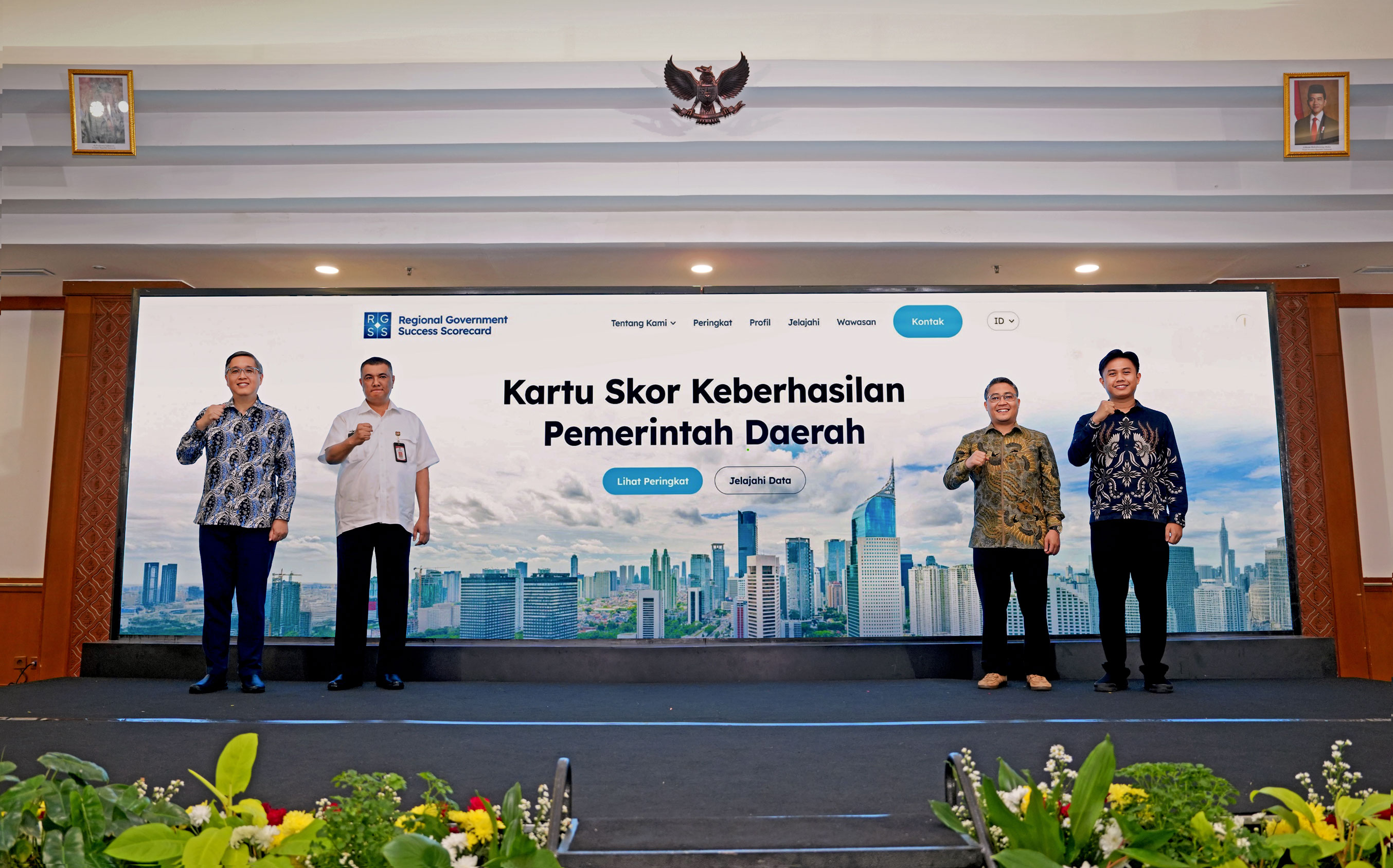
JAKARTA, (Indonesia), 3 June 2026 – The Regional Government Success Scorecard (RGSS) and its website were launched today in Jakarta. Developed by Chandler Governance Group (CGG), with support from the Gates Foundation, the RGSS is a data-driven tool designed to identify the key drivers of local government success. The Scorecard addresses the questions of “what works” and “why” to support better planning, policymaking, and budgeting by governments and their partners.
CGG subsequently worked with the Institute for Economic and Social Research, Faculty of Economics and Business, Universitas Indonesia (LPEM FEB UI), to adapt the RGSS for the Indonesian context. The Indonesia application provides a comparative and contextualised view of local government performance across Indonesia’s 514 cities (kota) and regencies (kabupaten), while accounting for the structural conditions in which each operates.
Supporting Informed Regional Governance Discussions
The launch seminar brought together senior officials from national ministries, leaders from local governments and academics. Keynote addresses were delivered by senior representatives of KEMENDAGRI and BAPPENAS, reflecting the relevance of the initiative to Indonesia’s regional development agenda.
Indonesia has placed growing emphasis on reducing disparities across regions and improving development outcomes nationwide. Subnational governments, from provinces to cities and regencies, account for a significant share of public expenditure, and their outputs and outcomes have direct implications for service delivery, socioeconomic outcomes, and citizen satisfaction.
The RGSS is designed to support discussions on improving local governance by surfacing insights on the factors associated with variation in local government outputs and outcomes, including public health, education, employment, and environmental quality.
The framework is organised around four pillars. The first three are ‘Capabilities’ (institutional capacity and quality), ‘Inputs’ (resources available to a local government), and ‘Performance’ (citizen-facing results). A fourth pillar, ‘Foundational Environment’, captures structural conditions, such as geography and natural-resource endowments, that lie largely outside a local government’s direct control.
To address the well-recognised challenge of comparing governments with vastly different structural starting points, the RGSS features a Dynamic Peer Comparison (DPC) methodology. Rather than measuring each local government against a single national benchmark with fixed comparison groups, DPC applies a continuous, similarity-weighted adjustment built into every score across the Scorecard, so that each local government is assessed against structurally similar peers. This directly responds to a common concern among practitioners that simple rankings can entrench structural advantage and penalise governments operating in more challenging environments.
"The RGSS is not a report card; it is a diagnostic tool. Our goal is to help national and local leaders better understand the factors associated with variation in governance outcomes and outputs across different contexts, and to surface practical lessons that can be shared across local governments. Indonesia’s 514 cities and regencies provide an important first country context for applying the RGSS, demonstrating how the tool can be adapted to large and diverse local government systems,"
said Mr Wu Wei Neng, Chief Executive Officer of the Chandler Governance Group.
RGSS for Indonesia Shaped by In-Depth Discussions with Indonesian Stakeholders
The RGSS for Indonesia was shaped through a year-long development process involving Indonesian ministries, agencies, local government associations, and policy researchers, helping to ensure that the framework reflects the country’s local governance context.
Over the course of this process, CGG and LPEM FEB UI conducted in-depth discussions with the Ministry of Home Affairs (KEMENDAGRI), the Central Statistics Agency (BPS), the Association of All Indonesian Regency Governments (APKASI), and the Association of Indonesian Municipal Governments (APEKSI). These discussions helped inform the Scorecard’s framework, indicator and metric selection, and approach to context adjustment.
"Strengthening regional governance requires approaches that are based on evidence and responsive to local needs. We welcome the RGSS initiative as a helpful tool to better understand the factors linked to differences in local government outcomes and performance across Indonesia. We hope this initiative can support constructive learning and informed policymaking among regional governments as they work to improve public services and development results,"
said Dr Heriyandi Roni, M.Si., Director of Regional Performance Evaluation and Capacity Building, KEMENDAGRI.
LPEM FEB UI, established in 1953 and one of Indonesia’s leading policy research institutes, served as a core academic partner throughout the design and validation of the localised RGSS for Indonesia. Khoirunurrofik, Ph.D, Head of the Public Finance and Development Planning Research Group of LPEM FEB UI said,
"The RGSS demonstrates the value of combining solid research, local context, and practical policy relevance in strengthening regional governance. Through our collaboration with CGG, we aimed to create a version of the RGSS that is methodologically strong and grounded in the realities and diversity of Indonesia’s local government landscape. We hope that the RGSS for Indonesia can add to broader evidence-based discussions on governance, public policy, and regional development in Indonesia."
A Dedicated RGSS Website For Indonesia
The launch also introduced the RGSS website which presents the broader RGSS framework and its first localised application in Indonesia. The website currently features local government profiles, rankings, and interactive data tools covering Indonesia’s 514 kota and kabupaten. Users can search, filter, and compare local governments side-by-side, and download data for further analysis. The platform also includes methodology documentation, dimension descriptions, and a series of analytical articles drawing on the Scorecard’s development and findings on factors associated with variation in local government outputs and outcomes across Indonesia.
Looking Ahead
As the first country application of the RGSS, Indonesia’s experience will help strengthen the framework’s relevance to diverse local government contexts and support its future adaptation in other countries.
CGG will continue working with LPEM FEB UI to further refine the Indonesia version of the RGSS in consultation with national and local stakeholders. At the same time, CGG will draw on lessons from the Indonesia application to refine the RGSS framework, methodology, and platform for adaptation in other country contexts.
About the Regional Government Success Scorecard (RGSS)
The Regional Government Success Scorecard (RGSS) is a data-driven tool developed by the Chandler Governance Group (CGG), with support from the Gates Foundation. It is designed to identify the key drivers of local government success, addressing the questions of “what works” and “why” to support better planning, policymaking, and budgeting by governments and their partners.
The RGSS is intended to be scalable and adaptable to different countries and local government contexts. Indonesia is the first country in the world in which the RGSS has been piloted. CGG worked with the Institute for Economic and Social Research, Faculty of Economics and Business, Universitas Indonesia (LPEM FEB UI), to develop a localised version of the RGSS for Indonesia.
The RGSS for Indonesia provides a comparative and contextualised view of local government performance across Indonesia’s 514 cities (kota) and regencies (kabupaten), while accounting for the structural conditions in which each operates. The accompanying RGSS website provides access to Indonesia local government profiles, methodology materials, indicator descriptions, and research and insight articles intended to support broader understanding of local government outcomes and outputs across Indonesia.
Learn more at https://regionalgovscorecard.org/.
About the Chandler Governance Group (CGG)
The Chandler Governance Group (CGG) is an international organisation focusing on public sector effectiveness and capability development. We work with national and local governments to train and develop leaders, strengthen public institutions and systems, benchmark government capabilities, and share good practices.
For more news and information, visit www.chandlergovernance.com or follow CGG on Facebook, X and LinkedIn @ChandlerGOV.
About the Institute for Economic and Social Research at Universitas Indonesia (LPEM FEB UI)
LPEM FEB UI is a leading research institute under the Faculty of Economics and Business, Universitas Indonesia. Established in 1953, LPEM FEB UI conducts policy-oriented research, consulting, and training to support evidence-based solutions for Indonesia’s economic and social development challenges. With a strong academic foundation and extensive experience working with government, private, and international partners, LPEM FEB UI has completed more than 1,500 research projects across areas such as regional economics, fiscal and monetary policy, trade, finance, labour, poverty, industry, and institutional development.
Learn more at https://en.lpem.org/.
For media clarifications, please contact:
Chandler Governance Group
Email: communications@Chandlergovernance.com


